

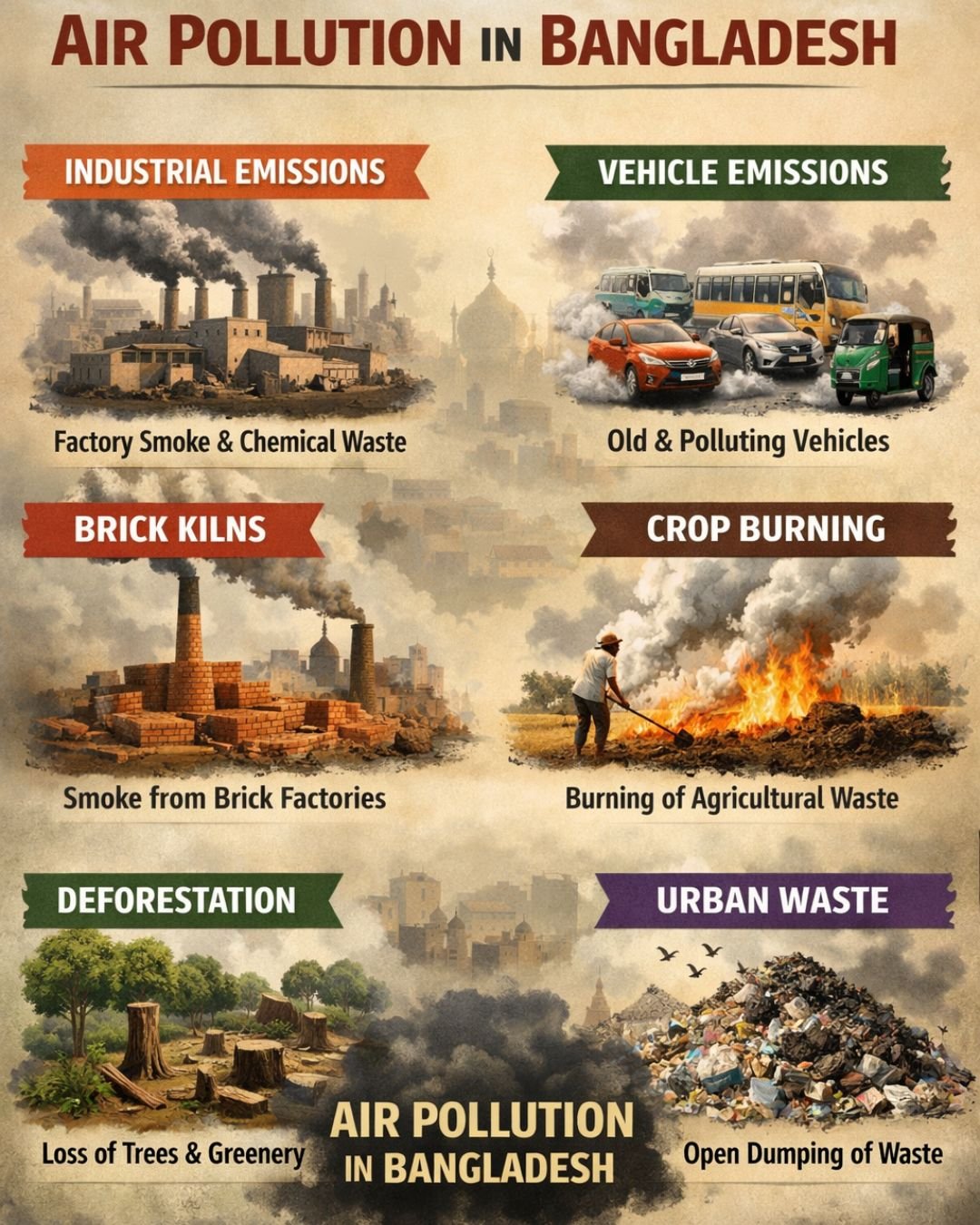
Air pollution is one of the most pressing environmental and public health crises in Bangladesh today. Every year, millions of people are exposed to air quality levels far above national and international safety standards, particularly in large cities like Dhaka and Chattogram. The problem becomes most severe during the dry winter months, when the air turns visibly hazy and breathing becomes difficult.
To address this crisis effectively, it is crucial to understand what are the main causes of air pollution in Bangladesh. Air pollution in the country is largely driven by human activities rapid urbanization, unregulated industrial growth, inefficient energy use, and weak enforcement of environmental laws. This article explains each major cause in detail and shows how they combine to create one of the most polluted urban environments in the world.
1. Brick Kilns: The Dominant Source of Air Pollution
Brick kilns are widely considered the largest single contributor to air pollution in Bangladesh, especially during the dry season.
Bangladesh relies heavily on fired clay bricks for construction, and as a result, thousands of brick kilns operate across the country. Most of these kilns burn low-grade coal, wood, and other inefficient fuels. The combustion process releases enormous amounts of fine particulate matter (PM2.5 and PM10), sulfur dioxide, carbon monoxide, and black carbon into the atmosphere.
Research conducted under the Clean Air and Sustainable Environment (CASE) Project shows that brick kilns alone are responsible for more than half of fine particulate pollution in Dhaka during winter months. These kilns typically operate from November to April, coinciding with low rainfall and poor air dispersion, which intensifies pollution levels.
Another major issue is the location of brick kilns. Many are clustered around city outskirts, meaning polluted air is easily carried into urban areas by prevailing winds.
2. Vehicle Emissions and Rapid Motorization
Vehicle emissions are the second most significant answer to the question what are the main causes of air pollution in Bangladesh.
The number of vehicles has increased dramatically over the past two decades due to population growth and urban expansion. Roads are congested with buses, trucks, private cars, motorcycles, and auto-rickshaws many of which are old, poorly maintained, or running on adulterated fuel.
Vehicle exhaust releases harmful pollutants such as:
- Carbon monoxide (CO)
- Nitrogen oxides (NOx)
- Hydrocarbons (HC)
- Fine particulate matter
Traffic congestion worsens the situation by keeping engines running longer at low speeds, which increases emissions per kilometer. According to air quality studies, vehicles contribute a significant share of urban air pollution, particularly in high-traffic zones.
3. Road Dust and Construction-Related Pollution
Road dust is a major but often underestimated contributor to air pollution in Bangladesh.
Rapid infrastructure development flyovers, metro rail projects, buildings, and highways has led to widespread excavation and material handling. Poorly paved roads, uncovered soil, sand piles, and broken asphalt generate large quantities of dust that remain suspended in the air.
During the dry season, the absence of rain allows dust particles to accumulate, increasing PM10 concentrations significantly. Studies indicate that road dust accounts for a substantial portion of urban particulate pollution, especially in Dhaka.
4. Industrial Emissions and Unregulated Factories
Industrial pollution is another critical component of air quality degradation.
Bangladesh’s industrial sector especially textile, garment, cement, steel, and chemical industries often operates with outdated technology and insufficient pollution control systems. Many factories are located close to residential areas, exposing communities directly to emissions.
Common pollutants from industries include:
- Sulfur dioxide
- Nitrogen oxides
- Volatile organic compounds (VOCs)
- Suspended particulate matter
Weak enforcement of environmental regulations allows many industries to exceed emission limits without facing penalties, making industrial pollution a persistent problem.
5. Open Burning of Waste and Biomass
Open burning is a widespread practice that significantly worsens air pollution.
This includes:
- Burning household and municipal waste
- Burning plastic and polythene
- Agricultural residue burning
- Biomass burning for cooking in rural areas
These activities release toxic gases, black carbon, and fine particles directly into the air. Open burning often takes place near homes, schools, and markets, increasing direct human exposure to pollutants.
6. Seasonal and Meteorological Conditions
Seasonal weather patterns play a crucial role in intensifying air pollution.
During winter:
- Rainfall is minimal
- Wind speed is low
- Temperature inversion traps pollutants near the ground
These conditions prevent pollutants from dispersing, causing pollution to build up over time. This explains why January and December consistently record the worst air quality levels in Bangladesh.
In contrast, air quality improves significantly during the monsoon season when rainfall washes pollutants out of the atmosphere.
7. Rapid Urbanization and Population Pressure
Unplanned urban growth amplifies all existing pollution sources.
As cities expand:
- More vehicles are added to roads
- Construction activity increases
- Energy demand rises
- Waste generation grows
Without adequate urban planning and environmental safeguards, rapid urbanization continues to worsen air pollution across the country.
Health and Environmental Impacts
The combined effect of these pollution sources has serious consequences:
- Increased respiratory diseases
- Higher rates of heart disease and stroke
- Reduced lung development in children
- Environmental degradation and reduced visibility
Long-term exposure to polluted air also places a heavy burden on Bangladesh’s healthcare system and economy.
So, what are the main causes of air pollution in Bangladesh?
The answer lies in a combination of brick kilns, vehicle emissions, road dust, industrial pollution, open burning, seasonal weather patterns, and unplanned urban growth.
Because most of these causes are human-made, they are also preventable. Cleaner technologies, strict enforcement of environmental laws, better urban planning, and public awareness can significantly improve air quality and protect public health.

Leave a Reply