
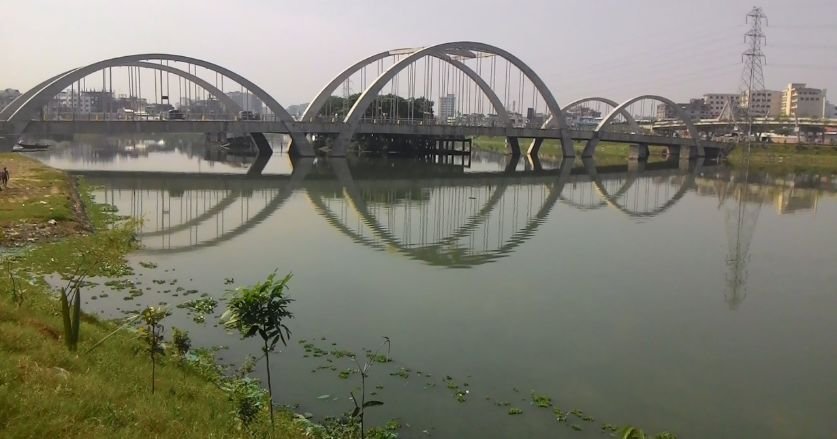
Maghbazar is one of the historic neighbourhoods of Dhaka, Bangladesh. Today, it is known as a busy urban area surrounded by major parts of the capital, including Eskaton, Ramna, Tejgaon, Malibagh and Siddheshwari. But the Maghbazar people see today is very different from the landscape that existed here several centuries ago.
The history of Maghbazar is closely connected with the Magh people of Arakan, the Mughal period, old settlements along the Pandu River, and the gradual expansion of Dhaka. The name itself is believed to preserve the memory of the Magh community that settled in the area. Historical sources, however, provide more than one explanation for exactly how that settlement developed.
Over the centuries, the area changed from a landscape of rivers, forests, ponds and agricultural land into a densely populated part of Dhaka. At the same time, several families continued to preserve stories about their ancestry, land, community leadership and connection with the old Magh settlement.
Where Is Maghbazar Located?
Maghbazar is located in central Dhaka. According to Banglapedia, the neighbourhood is bounded by Eskaton to the west, Ramna to the south, Tejgaon to the north and the Malibagh-Siddheshwari area to the east.
Its location has made Maghbazar an important connecting area within Dhaka. The neighbourhood sits close to several established residential, commercial and institutional areas, including Eskaton, Nayatola, Madhubagh, Siddheshwari, Malibagh and Tejgaon.
The historical Maghbazar area was also considerably broader than what people may understand by the name today. Research into the area’s history has included Nayatola, Madhubagh, Mirbagh, Mirertek, Eskaton, Bailey Road, Siddheshwari and the Wireless area within the wider historical description of Maghbazar.
This wider historical area helps explain why the history of Maghbazar cannot be understood simply by looking at the modern roads and buildings around Maghbazar intersection.
Why Is Maghbazar Called Maghbazar?
The name Maghbazar is generally associated with the Magh people of Arakan, a historical region corresponding broadly to present-day Rakhine State in Myanmar. Banglapedia states that the name appears to have been derived from the Maghs of Arakan.
The exact origin of the settlement, however, is not presented in exactly the same way by every historical source.
One account connects the area’s history with the Mughal defeat of the Maghs and the subsequent settlement of some members of the community in Dhaka. Another account suggests that Magh refugees arrived in Dhaka during the British period and established a settlement that later became known as Maghbazar. Banglapedia records both explanations.
Therefore, it is more accurate to say that Maghbazar’s name is historically associated with the Magh community, while the precise circumstances of the settlement have been explained differently by different historians.
The Maghs and the Early History of Maghbazar
To understand Maghbazar’s history, it is necessary to look at the political situation of Bengal during the Mughal period.
Historical accounts describe Magh forces from Arakan as a significant threat in parts of Bengal. They conducted raids in the region and were active along important waterways, including the Buriganga, Dhaleshwari, Shitalakshya and Meghna.
In 1620, the Mughals defeated the Maghs in a conflict associated with Dhaka. The detailed historical account published by The Business Standard states that the Maghs retreated with a large fleet and that around 4,000 boats were captured or abandoned in the conflict.
A later chapter in the story involves Mukut Ray, described in historical accounts as a nephew of the Arakan king and governor of Chittagong. Around 1630–35, he surrendered to the Mughal authorities and accepted Islam. According to the historical account, people associated with him were subsequently resettled near the Pandu River.
Banglapedia similarly connects the area with Magh settlement during the period of Subahdar Islam Khan II and says that the settlement later became known as Maghbazar.
The Pandu River and the Old Landscape of Maghbazar
The geography of old Maghbazar was very different from the neighbourhood that exists today.
Historical research describes the Pandu River as flowing through areas corresponding roughly to present-day Basabo, Khilgaon and Madartek. Karwan Bazar was described as one of its branches. Along the river were large areas of unused land, while dense vegetation covered much of the surrounding landscape.
The settlers gradually began to change the landscape. According to the historical account, they cleared parts of the jungle, cultivated the land and built houses.
This is an important part of Maghbazar’s history because it shows that the area was not originally the densely built-up neighbourhood people know today. Agriculture, waterways, ponds and forests played a major role in the area’s earlier life.
The transformation was also slow. Historical accounts describe Maghbazar as heavily forested well into the nineteenth century. Banglapedia notes that even toward the end of the nineteenth century the area was a dense forest inhabited by wild animals.
Maghbazar Was Once a Forested Area
Modern Maghbazar is difficult to associate with forests and wildlife, but historical descriptions provide a striking contrast.
The historical research cited by The Business Standard refers to descriptions of Maghbazar as a densely forested area even around a century or more ago. A newspaper report from 1856 reportedly described young men capturing three tiger cubs in the Maghbazar area.
This does not mean that today’s neighbourhood was covered by the same forest at every point in its history. Rather, it illustrates how much the surrounding environment changed as Dhaka expanded.
The source material you provided also describes old Maghbazar as a sparsely populated area where farmland, ponds and large family properties were once common.
Another Historical Account of the Magh Settlement
The history of Maghbazar does not come from one single account.
Historian Jatindra Mohan Roy presented another explanation of how Magh families came to settle in Dhaka. According to the account reported by The Business Standard, after the death of the king of Arakan, the king’s brother Dharmasa sought refuge with the faujdar of Bhulua. He reportedly arrived with more than 500 attendants.
They were subsequently sent to Dhaka, where Subahdar Islam Khan received them and granted them a taluk near the Pandu River. The group is said to have received financial assistance from the state treasury and established houses, a mosque and other structures.
There is also a tradition that when Prince Khurram, who later became Emperor Shah Jahan, visited Dhaka in 1624, Magh leaders met him and presented gifts. This particular detail is best treated as a historical tradition rather than an independently established fact.
These different accounts demonstrate why the history of Maghbazar should be presented carefully. There is substantial historical material connecting the area with Magh settlement, but individual details of the settlement story vary between sources.
The Old Mosque Associated With Maghbazar
Religious heritage is another important part of Maghbazar’s history.
Historical research describes an old mosque associated with the Magh community in the area between Maghbazar and Siddheshwari, close to the location of today’s Ramna Police Station. According to the account, the mosque was built for the followers of Mukut Ray after he and his followers accepted Islam.
The mosque was documented during the East India Company period. Charles D’Oyly served as Dhaka’s collector from 1808 to 1811 and produced drawings of several historic structures in Dhaka. One of the structures associated with his work was the old Maghbazar mosque.
The mosque was described as a small, single-domed brick structure with a stone inscription above the entrance.
According to the historical research, the inscription was written in Persian and recorded information about the construction of the mosque. The source also reports that the inscription remained on the building even after the Liberation War of 1971.
The original garden house associated with the Sardar family in Siddheshwari no longer exists, and the mosque itself has undergone changes. Nevertheless, these records provide an important connection between present-day Maghbazar and its older history.
Who Were the Old Families of Maghbazar?
The history of Maghbazar is also preserved through families who have lived in the area for generations.
In 2010, journalist and Dhaka history researcher Apel Mahmud began investigating whether descendants of the old Magh community were still living in the area. His research identified several families in Maghbazar, Madhubagh, Nayatola, Dilu Road and Eskaton who identify themselves as descendants of the Magh royal lineage.
The families mentioned in the research include the Sardar family around Maghbazar intersection, the Sheikh Dilu family of Dilu Road, the Sheikh Jumman Baksh and Abbas Sheikh families of Nayatola, the Ali Baksh family of Madhubagh, the Mohammad Ali family of Mirbagh, descendants of Yusuf and Julfu Bepari in Eskaton and the family of Shamsuddin Sheikh in New Eskaton.
However, this should not be presented as proof that every family claiming such ancestry has a conclusively established genealogy.
Historian Professor Sharifuddin Ahmed has said that the claims of people identifying themselves as descendants of the original Arakanese Maghs are not entirely without basis, but that the subject requires further scholarly research.
That distinction is important when discussing Maghbazar’s heritage.
Agriculture and Everyday Life in Old Maghbazar
Long before Maghbazar became a dense urban neighbourhood, agriculture was an important part of local life.
According to recollections recorded during Apel Mahmud’s research, families in Maghbazar, Nayatola, Madhubagh and surrounding areas once cultivated rice, caught fish and depended on ponds and farmland. Before Partition, the population of the wider area was relatively small and many residents were involved in farming.
The area was also known for agricultural produce. Historical recollections specifically mention the popularity of eggplants and bottle gourds grown in Maghbazar among residents of old Dhaka.
The source material you provided gives an even clearer picture of the old landscape: ponds were used for bathing and fishing, while rice cultivation took place around family properties. Large compounds could include gardens, trees, cowsheds and cultivated land.
This agricultural past is one of the strongest contrasts between old and modern Maghbazar.
The Sardar Family and Maghbazar’s Panchayat Tradition
The Sardar family holds a particularly important place in accounts of old Maghbazar.
According to the historical research, the first Sardar of the family was Hanif Baksh, the son of Rahim Baksh. Nawab Abdul Gani is said to have ceremonially placed a turban on Hanif Baksh’s head.
A later descendant, Osman Gani Sardar (1906–1976), became the Sardar of Dhaka’s Baish Panchayat, or Council of Twenty-Two. A road leading from the Maghbazar area toward the FDC direction was later named Osman Gani Road.
A plaque installed by Dhaka North City Corporation describes Osman Gani as a social worker and philanthropist. The plaque also credits him with donating land and money for mosques, madrasas and schools and refers to his involvement in the Language Movement and Liberation War.
The panchayat system itself is an important part of old Dhaka’s social history. Historian Nazir Hossain wrote that the panchayat system existed in Dhaka from the Mughal period and continued despite major political, social and economic changes.
What Was Life Like in the Sardar Family Home?
The memories preserved by descendants provide a detailed picture of life in old Maghbazar.
The original Sardar family home was described as a single-storey structure made using lime and brick, with mango and jackfruit trees around the courtyard. There was also a cowshed at the back and cultivated land nearby.
Family members also recalled a pond connected with their garden house. The pond was located where Century Arcade Shopping Mall now stands and was later known as Ispahani Pond.
These details show how dramatically the neighbourhood’s physical environment changed. A place that once contained family gardens, ponds, trees and cultivated land is now part of one of Dhaka’s densely developed urban areas.
Maghbazar and the Old Waterways
Waterways played an important role in the daily life of old Maghbazar.
Historical recollections describe the Rampura Canal as navigable at the time. Boats carrying jackfruit and earthenware reportedly travelled from areas such as Beraid and Satarakul toward Maghbazar.
For local residents, waterways were not simply a means of transporting goods. They were also part of everyday recreation.
Members of the Sardar family reportedly travelled by boat to Beraid in the afternoons, while women travelled to visit relatives in enclosed horse-drawn carriages.
Such memories provide a glimpse of a Dhaka that existed before the modern road network and large-scale urban development transformed the city.
Osman Gani Sardar and Community Service
Osman Gani Sardar’s story goes beyond his position within the panchayat system.
Historical accounts describe him as a community leader who contributed land and money to religious and educational institutions. His legacy is also associated with social service and philanthropy.
The family tradition continued through later generations, who remembered him as a generous and hospitable person.
According to his descendants, he and his family were known for entertaining guests and helping resolve disputes within the community. One family account describes a practice of feeding both parties before discussing disputes, reflecting the social customs of the period.
These accounts should be understood as family recollections rather than independently verified descriptions of every event. Nevertheless, they are valuable for understanding how residents remember the social life of old Maghbazar.
The Maghbazar Government Primary School
Education is another part of the neighbourhood’s historical development.
According to a descendant of the Sardar family quoted in the historical investigation, the family established an early school in a tin-roofed structure at Maghbazar intersection. The family identifies this institution as the predecessor of what is now Maghbazar Government Primary School.
Whether every aspect of this institutional lineage can be independently established requires archival research, but the account forms part of the local history preserved by descendants of old Maghbazar families.
Today, Maghbazar and its surrounding areas contain numerous educational institutions, reflecting the neighbourhood’s transformation into an established urban centre.
Maghbazar’s Educational and Medical Institutions
Modern Maghbazar is surrounded by schools, colleges, medical institutions and other educational facilities.
Institutions associated with the area include Ispahani Girls School and College, Sacred Heart Tutorial School, National Bank Public School and College, Maghbazar Government Primary School and several other schools and colleges.
The wider area is also home to medical and dental institutions. This includes institutions such as Holy Family Medical College, Ad-din Women’s Medical College, Dr. Sirajul Islam Medical College and University Dental College, among others.
The Dhaka Education Board’s SSC centre list also includes Maghbazar Ispahani Madhyamik Girls’ High School under the Ramna area.
These institutions demonstrate the role Maghbazar now plays as an established education and healthcare hub within central Dhaka.
The Families Who Lost Much of Their Land
Urbanisation brought major changes to the old families of Maghbazar.
According to Tofazzal Hossain Khan, the grandson of Ali Baksh Khan, some old families once owned around 100 to 150 bighas of land. Many later lost much of their property as the city changed and families struggled to adapt to modern urbanisation.
Family accounts also describe how large gardens, ponds and agricultural properties gradually disappeared as Dhaka expanded.
This process was not unique to Maghbazar. Similar changes occurred throughout Dhaka as agricultural and semi-rural areas were gradually incorporated into the growing metropolitan city.
Shah Nuri and Maghbazar’s Religious Heritage
Maghbazar also became associated with the spiritual tradition of Shah Nuri.
Historical accounts state that Shah Nuri Bengali established a khanqah in Maghbazar in the late eighteenth century. The khanqah reportedly attracted people from different parts of Dhaka, including members of the city’s elite.
The connection between local families and religious figures also appears in family histories. For example, descendants of Sheikh Jumman Baksh of Nayatola have said that their ancestors came from Chittagong and became disciples of Pir Shah Nuri of Maghbazar.
This adds another layer to the area’s history: Maghbazar was not simply an agricultural settlement but also developed as a place with religious and community significance.
The Cultural Memories of Old Maghbazar
The memories preserved by old families reveal a social world that has almost completely disappeared.
Family accounts describe large garden houses where people gathered for meals, social events and community activities. Before professional decorators became common in Dhaka, residents reportedly borrowed items such as carpets, canopies and utensils from prominent family homes for events.
There were also stories of music and entertainment. Sadeq Baksh, a descendant of Sheikh Jumman Baksh of Nayatola, was remembered as a skilled violinist who was known in areas such as Beraid and Satarakul.
These accounts illustrate the cultural diversity of old Dhaka’s neighbourhood life and the role that established families played in local society.
From Farmland to a Busy Urban Neighbourhood
The transformation of Maghbazar happened gradually as Dhaka expanded.
Land that was once used for rice cultivation and vegetable farming was increasingly occupied by houses, roads, businesses and institutions. Ponds and gardens disappeared, waterways became less important for everyday transportation, and the population grew.
The old landscape described in historical accounts—forests, agricultural fields, ponds, canals and large family compounds—has largely been replaced by modern urban development.
The change is particularly striking when compared with historical descriptions of the area as sparsely populated and heavily forested.
Maghbazar’s Administrative Areas
Modern Maghbazar is associated with Dhaka North City Corporation’s administrative structure.
The broader area is associated with Wards 35 and 36. Historical and administrative descriptions identify areas such as Boro Maghbazar, Dilu Road, New Eskaton Road and parts of Nayatola within the surrounding ward structure.
Ward boundaries and administrative jurisdictions can change, so anyone looking for an exact current administrative address should verify it against the latest Dhaka North City Corporation records.
For historical purposes, however, it is useful to remember that the old Maghbazar area extended across a considerably wider landscape than the modern neighbourhood name suggests.
Maghbazar and Its Neighbouring Areas
Maghbazar’s location has always connected it with several important parts of Dhaka.
Eskaton lies to the west, Ramna to the south, Tejgaon to the north and Malibagh-Siddheshwari to the east.
Within the wider historical area, places such as Nayatola, Madhubagh, Mirbagh, Mirertek, Siddheshwari and the Wireless area have also been closely connected with Maghbazar’s history.
This geographical connection is one reason Maghbazar has remained an important urban locality even after its original landscape disappeared.
What Happened to the Magh Descendants?
One of the most interesting questions surrounding Maghbazar is whether descendants of the original Magh settlers are still present.
The answer requires some caution.
Research conducted by Apel Mahmud identified several families who identify themselves as descendants of the Magh royal lineage. Some families continue to take pride in that identity and preserve stories about their ancestors.
However, historians have also pointed out that more research is needed to establish these genealogical claims conclusively.
Therefore, it would be inaccurate to state as an established fact that every family making such a claim has been scientifically or historically proven to descend from the original Magh royal family. What can be established is that these family traditions exist and form an important part of Maghbazar’s living historical memory.
Maghbazar in the Past and Present
The contrast between old and modern Maghbazar is remarkable.
In earlier centuries, the area was associated with rivers, forests, farmland and relatively small settlements. Families cultivated crops, caught fish and lived around ponds and gardens. Boats were used along nearby waterways, and traditional community structures played an important role in local affairs.
Today, Maghbazar is a highly developed part of Dhaka. Roads, apartment buildings, commercial establishments, schools, hospitals and other institutions dominate the landscape.
Yet the area’s name has survived.
Every time the name “Maghbazar” is used, it carries a reference to a much older chapter in the history of Dhaka—the settlement and legacy of people associated with the Magh community.
Maghbazar is much more than a busy intersection in central Dhaka. It is a neighbourhood whose name preserves a long and complicated history.
Its story begins with the Magh community and their connection with Arakan, continues through the Mughal period and the settlement of families near the Pandu River, and extends into the agricultural and community life of nineteenth- and twentieth-century Dhaka.
For generations, families associated with the area cultivated land, managed large properties, maintained ponds and gardens, participated in local panchayat traditions and supported schools and religious institutions. Some descendants still preserve stories about their ancestry and the landscape their families once knew.
At the same time, Maghbazar’s history should be approached carefully. Some details come from established historical sources, while others survive through family traditions and accounts that historians say require further research.
That combination of documented history and living memory is what makes Maghbazar particularly fascinating. The modern neighbourhood with its busy roads, buildings, schools, hospitals and businesses—stands on a landscape that once contained forests, ponds, farmland and waterways.
Understanding Maghbazar therefore offers more than the history of one neighbourhood. It provides a small but revealing window into how Dhaka itself changed from a historic riverine settlement into the vast metropolitan city it is today.
Frequently Asked Questions About Maghbazar
Where is Maghbazar located?
Maghbazar is a neighbourhood in central Dhaka. It is broadly bounded by Eskaton to the west, Ramna to the south, Tejgaon to the north and Malibagh-Siddheshwari to the east.
Why is Maghbazar called Maghbazar?
The name Maghbazar is generally believed to have originated from the Magh people associated with Arakan. Historical sources provide different accounts of how Magh communities came to settle in the area.
What is the history of Maghbazar?
Maghbazar’s history is closely connected with the Mughal period, the Magh community of Arakan, settlements along the Pandu River and the later urban development of Dhaka.
Was Maghbazar once a forest?
Yes. Historical accounts describe Maghbazar and its surrounding areas as heavily forested. Even in the nineteenth century, parts of the area contained dense vegetation and wildlife.
Did the Magh community live in Maghbazar?
Historical sources strongly associate Maghbazar with Magh settlement. Accounts differ over the precise circumstances and timing, but the connection between the Magh community and the area’s name is well established.
Are Magh descendants still living in Maghbazar?
Some families in Maghbazar and nearby areas identify themselves as descendants of the old Magh royal lineage. Historians have acknowledged that these claims are not necessarily without foundation but have also said that further research is needed to establish the genealogies conclusively.
What was Maghbazar like in the past?
Old Maghbazar had a much more rural landscape than it does today. Historical recollections describe farmland, ponds, gardens, waterways and relatively small settlements. Many residents were involved in farming and fishing.
What are the major historical features of Maghbazar?
The area’s historical features include its association with Magh settlement, the old mosque connected with the community, the Pandu River landscape, the traditional panchayat system, old family estates and the religious heritage associated with Shah Nuri.
References:
1. https://www.tbsnews.net/bangla/feature/news-details-411071
3. https://en.wikipedia.org/wiki/Maghbazar