

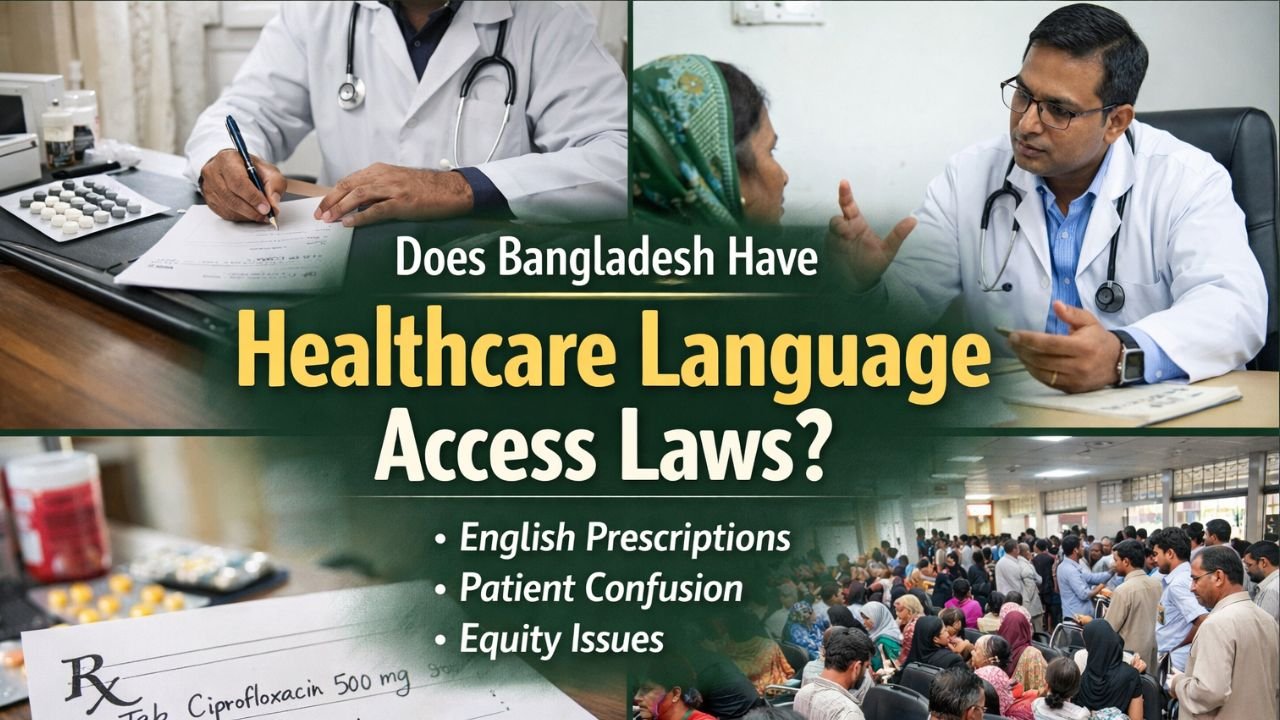
Short answer: Bangladesh does not currently have a specific, comprehensive healthcare language access law.
Language access in healthcare exists in practice through informal methods and professional norms—but not through a clearly defined legal framework. This gap has real consequences for patient safety, treatment outcomes, and health equity.
This blog explores whether Bangladesh has healthcare language access laws, why the issue matters, and what research tells us about the impact of medical language barriers in the country.
What Are Healthcare Language Access Laws?
Healthcare language access laws are policies or regulations that ensure patients can understand and be understood when receiving medical care. These laws typically require:
- Use of a patient’s native or preferred language
- Clear, understandable prescriptions and instructions
- Interpretation services where needed
- Patient-friendly medical communication
Many countries embed these protections within health acts, patient rights charters, or anti-discrimination laws.
Does Bangladesh Have Healthcare Language Access Laws?
At present, Bangladesh does not have a dedicated healthcare language access law that mandates doctors or hospitals to communicate with patients in a language they understand.
However, several contextual factors shape healthcare communication:
- Bengali (Bangla) is the mother tongue of about 98% of the population
- English is widely used in:
- Medical education
- Prescriptions
- Discharge certificates
- Medical documentation
- Medical terminology is often influenced by English, Latin, and Greek
This creates a systemic mismatch between the language used by healthcare providers and what many patients can realistically understand.
What Research Says About Medical Language Barriers in Bangladesh
An exploratory study published in BJGP Open (2019) examined whether medical language acts as a barrier to healthcare access in Bangladesh. The findings highlight why the absence of formal language access laws is a serious issue.
Key Findings
- 44% of prescriptions are written entirely in English
- 26% use a mix of English and Bengali
- 30% of patients could not understand the medical language used
- 78% reported that medical language affected the treatment process
- 48% believed medical language was a direct barrier to receiving healthcare
These results clearly indicate that language itself is a hidden obstacle within the healthcare system.
Why the Lack of Language Access Laws Is a Problem
1. Patient Safety Risks
When patients cannot understand prescriptions or instructions:
- Medicines may be taken incorrectly
- Side effects may go unrecognized
- Follow-up care may be ignored
2. Health Inequality
Bangladesh’s literacy rate is around 73%, and many literate individuals can read only Bengali, not English. This means:
- Vulnerable populations face greater risk
- Illiterate patients are especially disadvantaged
3. Weak Doctor–Patient Communication
Without legal or policy guidance:
- Communication depends on individual doctors’ habits
- No accountability exists for unclear medical language
Are There Any Informal Language Practices?
Yes. While no formal law exists, some practices help reduce barriers:
- Verbal explanations in Bengali during consultations
- Medicine leaflets printed in both Bengali and English
- Pharmacists explaining dosage verbally
However, these practices are inconsistent, unregulated, and dependent on individual effort, not legal obligation.
What Could Healthcare Language Access Look Like in Bangladesh?
Based on research evidence and patient feedback, several policy-level improvements are possible:
Practical Policy Recommendations
- Prescriptions written with:
- Medicine names in English block letters
- Instructions in Bengali
- Mandatory verbal explanation of diagnosis and medication
- Use of visual aids, symbols, or illustrations
- Bengali-first communication standards in public healthcare
- Inclusion of language access principles in national health policy
Does Bangladesh Need Healthcare Language Access Laws?
Yes—urgently.
The evidence shows that medical language is not a minor inconvenience; it is a structural barrier that affects diagnosis, treatment adherence, and patient trust.
Introducing clear healthcare language access guidelines or laws would:
- Improve patient safety
- Strengthen doctor–patient relationships
- Reduce preventable medical errors
- Promote equitable healthcare access
So, does Bangladesh have healthcare language access laws?
No, not yet.
But research clearly shows that medical language barriers are real, widespread, and harmful. Addressing this gap does not require expensive technology just thoughtful policy, cultural awareness, and patient-centered communication.

Leave a Reply