
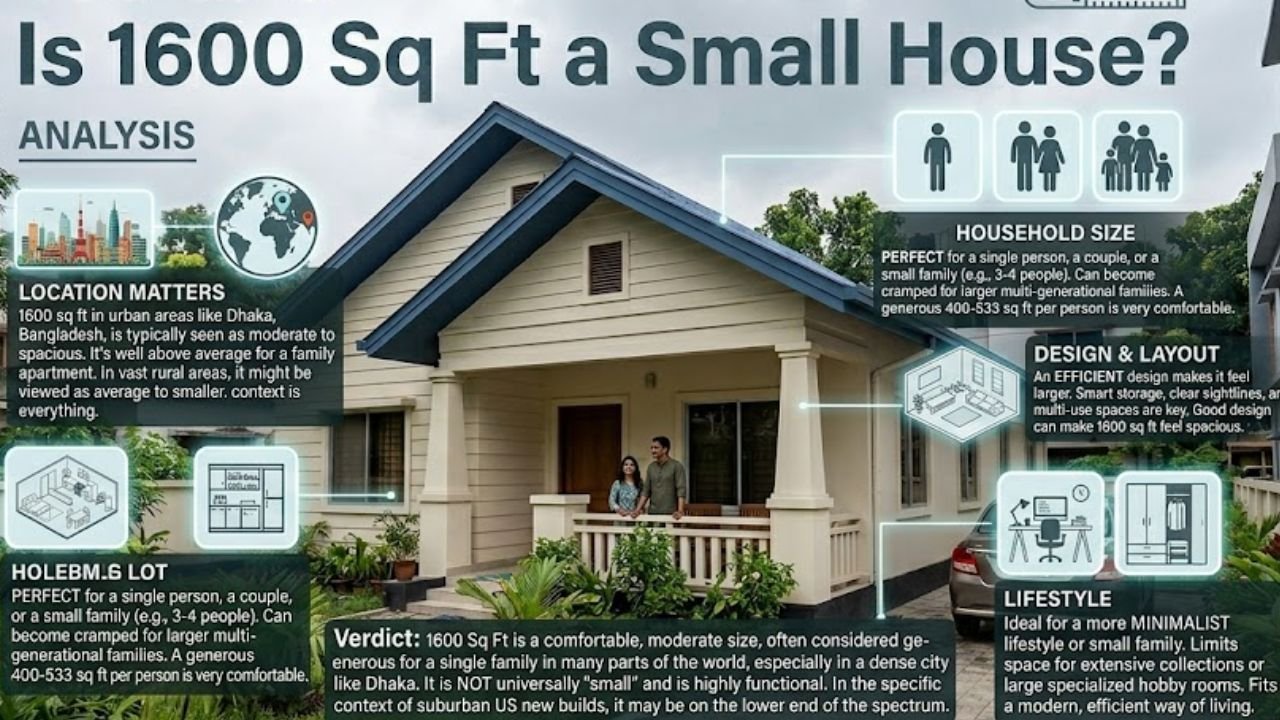
When searching for a new home, one of the most common questions prospective buyers ask is, is 1600 sq ft a small house? It is a fair question, especially with the wide range of floor plans available in the current market. For many American families, the answer is not as straightforward as a simple yes or no. While it might feel snug to some, others consider it a perfectly comfortable and highly efficient space. This comprehensive guide will analyze this residential square footage through the lens of modern data, regional differences, and smart spatial design, providing a clear picture of what this size truly offers.
Defining “Small”: Context Over Square Footage
To determine whether 1,600 square feet qualifies as small, one must first look at the regional and national benchmarks. The definition of a compact or moderate home is highly subjective and shifts based on location. For instance, in a densely populated urban environment where apartments are the norm, 1,600 square feet is often considered a spacious sanctuary, offering far more room than the typical city dwelling. Conversely, in sprawling suburban developments where 2,500 to 3,000 square feet is standard, a 1,600-square-foot house can indeed feel like a downsized option.
Many real estate professionals and architects generally classify residences falling within the 600 to 1,200 square foot range as a small house. Following this logic, 1,600 square feet sits comfortably above that threshold. According to industry analysis, it is frequently described not as “small” but as a “moderately sized home” that strikes a functional balance between cozy and cramped. It provides enough breathing room to avoid the feeling of being tightly boxed in, which is often the primary concern for those accustomed to larger layouts.
National Averages and Regional Realities
The current statistical landscape of the housing market provides crucial context for the is 1600 sq ft a small house debate. The average size of a new single-family home in the United States currently sits near 2,400 square feet, though the median size is closer to 2,160 square feet. However, when looking at existing homes rather than just new construction, the national average drops to approximately 1,800 to 1,900 square feet. When a home is compared against the average new build, 1,600 square feet sits about 25% smaller, which explains why it often gets labeled as a compact option.
Yet, the perception changes drastically when examining state-by-state data. In high-cost real estate markets, 1,600 square feet is not only common but often the norm. For example, the average home size in New York is around 1,500 square feet, while in Hawaii, the average drops to approximately 1,164 square feet. In these states, a 1,600-square-foot residence would be considered an average or even slightly above-average property. In contrast, states like Utah (averaging 2,800 sq ft) or Colorado (averaging 2,500 sq ft) would undoubtedly view 1,600 square feet as significantly smaller than the regional standard.
Functionality and Layout Efficiency
Rather than fixating solely on the raw number, a buyer must ask how that floor plan is utilized. One of the greatest advantages of the 1,600-square-foot design is its ability to comfortably accommodate a standard three-bedroom, two-bathroom configuration without requiring the homeowner to sacrifice essential living spaces. A well-designed 1,600-square-foot house can easily include a living room, a formal or casual dining area, a kitchen with an island, a primary suite, and two secondary bedrooms.
The feeling of spaciousness in a moderately sized home is largely determined by the architectural flow. An open floor plan can make a 1,600-square-foot home feel significantly larger than a 2,000-square-foot home that is chopped up into tiny, disconnected rooms. By removing unnecessary interior walls between the kitchen, dining, and living areas, the home feels airy and expansive. Additionally, modern design features such as large windows, vaulted ceilings, and sliding glass doors that open to a patio or deck help blur the lines between indoor and outdoor living, further enhancing the sense of space.
The Shift Toward Moderate Living
The American obsession with “McMansions” has been cooling off in recent years, and a shift toward more moderate living is currently reshaping the housing industry. Since the mid-2010s, the average residential size has generally been trending downward. Builders are responding to affordability challenges and a change in consumer preferences. There is a growing realization that a massive square footage often leads to higher utility bills, more expensive maintenance, and rooms that rarely get used. Many homeowners are finding that they prefer a smaller, well-organized home with lower operational costs over a sprawling property that requires constant upkeep.
Furthermore, the rise of remote and hybrid work has changed how space is valued. In the past, the allure of a large home was often tied to having a dedicated office or a playroom. Today, designers are proving that these needs can be met in 1,600 square feet through clever zoning and multifunctional furniture. A breakfast nook can double as a workspace, or a finished basement can serve as both a media room and a guest suite. This efficient use of square footage means that 1,600 square feet is less likely to be viewed as a “small” restriction and more as an efficient blank canvas.
Making the Right Choice for Your Household
Ultimately, the label of “small” is less important than the question of “sufficient.” For a single person or a couple, 1,600 square feet is usually a luxury of space, offering the possibility of a guest room, a home gym, and a dedicated office with room to spare. For a family of four, it moves into the “cozy but comfortable” category. It encourages family members to utilize shared spaces, which can actually foster closer relationships and reduce isolation.
To ensure a 1,600-square-foot home works for you, consider the following strategies:
- Prioritize Storage: Built-in shelving, under-stair storage, and vertical cabinets are essential to keep clutter at bay.
- Evaluate the Exterior: Does the property have a garage, basement, or attic? These non-living spaces add tremendous value for storing seasonal items, tools, and hobby equipment.
- Think Vertically: If the home allows, adding a loft or expanding upwards can provide additional breathing room without increasing the physical footprint of the house.
So, is 1600 sq ft a small house? The most accurate answer is that it sits right on the borderline. While it is smaller than the average newly constructed home in many parts of the country, it is notably larger than what is technically defined as a “small house” by real estate standards. It represents a middle ground of moderate, efficient, and practical living. For those looking to avoid the financial burden and maintenance of a massive estate while still enjoying distinct, separate living spaces, 1,600 square feet is not small at all—it is the perfect size.